
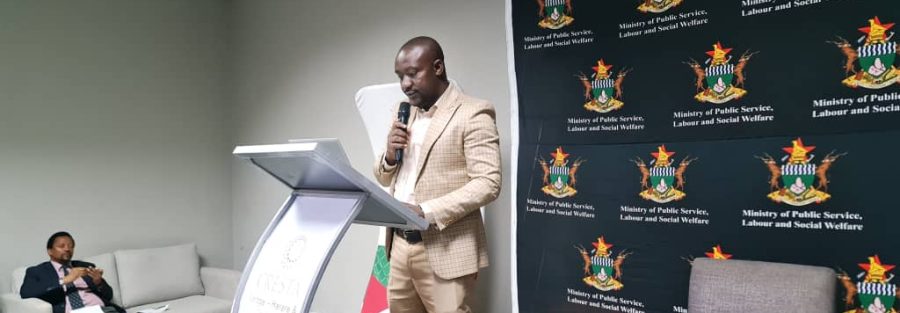
The Vendors Initiative for Social and Economic Transformation (VISET) welcomes the convening of the Half-Day Multi-Stakeholder Workshop on the Implementation of Zimbabwe’s National Formalisation Strategy, organised by the Ministry of Public Service, Labour and Social Welfare, in collaboration with the International Labour Organization (ILO) and the Labour and Economic Development Research Institute of Zimbabwe (LEDRIZ). The workshop marks an important milestone in translating Zimbabwe’s Formalisation Strategy from policy into action and reinforces the country’s commitment to promoting decent work, inclusive economic growth and sustainable livelihoods. The Strategy seeks to facilitate the transition from the informal to the formal economy through a coordinated, inclusive and developmental approach that aligns with national development priorities.
VISET recognises that the National Formalisation Strategy is anchored within Zimbabwe’s broader National Development Strategy 2 (NDS2), which identifies formalisation as a key driver of employment creation, productivity, enterprise development and inclusive economic transformation. The Strategy contributes directly to national targets of increasing formal employment, reducing informality, expanding decent work opportunities and strengthening the growth of micro, small and medium enterprises. It also reflects Zimbabwe’s commitment to Sustainable Development Goal 8 and the principles of ILO Recommendation 204 on the Transition from the Informal to the Formal Economy.
As an organisation representing thousands of informal economy workers across Zimbabwe, VISET welcomes the recognition that informal economy workers are not a problem to be solved but an essential pillar of the national economy. For decades, vendors, cross-border traders, transport operators, home-based workers, waste pickers and other informal workers have sustained households, created employment and contributed to local economic development despite operating in an environment characterised by limited infrastructure, inadequate social protection and regulatory barriers. The adoption of this Strategy provides an opportunity to transform that reality through policies that support rather than penalise the informal economy.
During the workshop, VISET Executive Director Samuel Wadzai – while delivering remarks on behalf of Informal Economy Associations – emphasised that the true success of the National Formalisation Strategy will not be determined by the quality of the policy document itself, but by the effectiveness, inclusiveness and accountability of its implementation. He noted that informal economy workers must move from being passive beneficiaries of policy to becoming equal partners in its implementation. The principle of “Nothing for us without us” should guide every stage of implementation, ensuring that representative organisations of informal economy workers actively participate in planning, implementation, decision-making and evaluation at national, provincial and local authority levels.
VISET further stressed that meaningful formalisation can only be achieved if the voices of communities remain central throughout implementation. Policies must respond to the lived realities of those operating within the informal economy rather than imposing one-size-fits-all solutions. Community structures, informal economy associations and grassroots organisations should therefore become permanent platforms for dialogue, consultation, evidence generation and accountability, ensuring that implementation remains responsive to local priorities and challenges.
The organisation also called for the establishment of a sustainable financing framework to support implementation of the Strategy. Formalisation requires investment in market infrastructure, access to affordable finance, enterprise development, skills training, digital innovation, social protection systems and institutional capacity. Without dedicated financial resources from Government, development partners, local authorities and the private sector, implementation risks becoming another policy aspiration that fails to produce measurable change for informal economy workers.
VISET equally underscored the importance of developing an inclusive Monitoring and Evaluation Framework that places informal economy workers at the centre of measuring progress. Such a framework should include clear performance indicators, regular multi-stakeholder reviews, community-based monitoring systems and mechanisms that enable informal economy organisations to assess implementation alongside Government and development partners. Transparency, accountability and evidence-based learning should become defining features of the Strategy’s implementation.
The organisation welcomed the Strategy’s recognition that formalisation is a gradual, developmental and context-specific process that should preserve and improve existing livelihoods while expanding opportunities for decent work, productivity and enterprise growth. VISET believes that formalisation should create incentives for participation by simplifying registration procedures, improving access to markets and public procurement, extending social protection coverage, strengthening representation and ensuring policy coherence across institutions.
VISET reaffirms its commitment to working alongside the Government of Zimbabwe, the International Labour Organization, organised labour, employers, local authorities, development partners and other stakeholders to support implementation of the National Formalisation Strategy. Through its nationwide structures, evidence-based advocacy, community mobilisation and policy engagement, VISET stands ready to facilitate dialogue between Government and informal economy workers while promoting practical solutions that improve livelihoods and strengthen inclusive economic development.
The organisation calls upon all stakeholders to seize this historic opportunity to build a formalisation process that is participatory, adequately financed, accountable and responsive to the aspirations of Zimbabwe’s informal economy workers. Zimbabwe now has an opportunity to demonstrate that sustainable economic transformation can only be achieved when those who constitute the majority of the workforce are recognised, respected and empowered as partners in national development.
“Let history remember us not as the generation that produced another policy document, but as the generation that transformed a vision into action, participation into ownership, and hope into lasting opportunity for millions of informal economy workers. The strength of any nation is not measured by the size of its formal economy alone, but by its ability to recognise, respect and invest in the dignity and potential of every worker. When the informal economy thrives, Zimbabwe thrives.” Wadzai said